Every year, many manufacturing companies repeat the same budgeting ritual.
Finance teams collect numbers from each department.
Operations submits next year’s production needs.
Procurement estimates raw material costs.
Management reviews the spreadsheet.
Then, somewhere along the way, the company arrives at a number that looks very familiar:
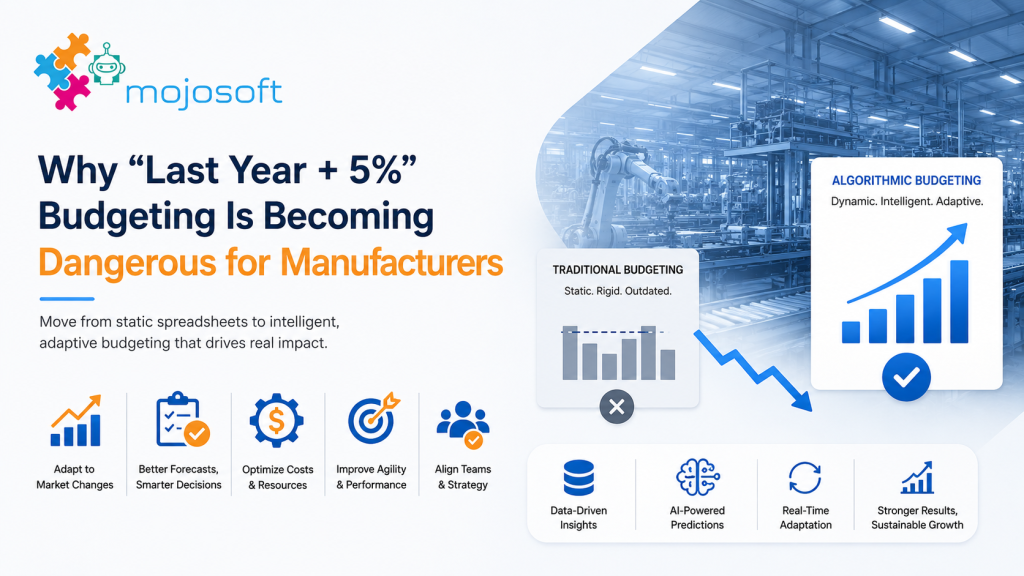
Last year’s budget, plus 5%.
For decades, this approach was “good enough.”
When markets were more stable, suppliers were predictable, energy costs were manageable, and customer demand moved within a reasonable range, incremental budgeting made sense.
But today, we are no longer operating in that world.
Manufacturers are now dealing with:
Rising energy costs.
Unstable raw material prices.
Supply chain disruption.
Labor shortages.
Foreign exchange volatility.
Geopolitical risk.
Customer demand that changes faster than before.
In this environment, a static annual budget is no longer just outdated.
It can become a strategic liability.
The Problem with Traditional Budgeting
Traditional budgeting assumes that the future will look mostly like the past.
But manufacturing does not work that way anymore.
A factory may prepare its budget based on expected raw material prices, only to find that prices increase sharply three months later.
A production plan may assume stable labor availability, only to face overtime pressure because skilled workers are difficult to find.
A maintenance budget may be reduced to save costs, only for one critical machine failure to disrupt delivery schedules and damage customer trust.
The issue is not that budgeting is wrong.
The issue is that many companies still treat the budget as a fixed document, instead of a living management tool.
This creates three common problems.

1. Finance Spends Too Much Time Explaining Variance
In many companies, budget review meetings become variance explanation meetings.
Why did raw material costs exceed budget?
Why did maintenance spending increase?
Why was overtime higher than expected?
Why did logistics cost more than planned?
The finance team spends too much time explaining what already happened.
But the real value of finance should be helping management decide what to do next.
A good budgeting process should not only answer:
“What went wrong?”
It should also answer:
“What is likely to happen next, and how should we respond?”
2. Departments Protect Their Budget Instead of Optimizing the Business
Traditional budgeting often creates the “use it or lose it” mentality.
If a department does not spend its budget this year, it may fear getting a smaller budget next year.
So instead of optimizing company-wide performance, departments start protecting their own allocation.
This creates trapped capital.
Money sits in one department even when another part of the business urgently needs it.
For example, procurement may need extra budget to buy raw materials early before prices increase further. But the money may be locked somewhere else because the budget was fixed months ago.
This is not agility.
This is bureaucracy.
3. External Market Signals Are Ignored
Many budgets are built mainly from internal historical numbers.
Last year’s sales.
Last year’s production volume.
Last year’s labor cost.
Last year’s maintenance spending.
But many of today’s biggest cost drivers come from outside the company.
Commodity prices.
Shipping rates.
Fuel prices.
Exchange rates.
Trade restrictions.
Weather disruptions.
Supplier instability.
If the budget does not include these external signals, management is basically driving by looking only at the rear-view mirror.
That is dangerous in a volatile market.
The Rise of Algorithmic Budgeting
This is where algorithmic budgeting becomes highly relevant.
Algorithmic budgeting uses data, machine learning, and predictive models to help companies build budgets that are more dynamic, more realistic, and more responsive to changing conditions.
Instead of asking:
“How much did we spend last year?”
It asks:
“What are the key variables that will influence our cost, margin, cash flow, and capacity next year?”
For manufacturers, these variables may include:
Raw material price trends.
Machine efficiency.
Production yield.
Energy usage.
Labor availability.
Overtime patterns.
Supplier lead time.
Customer demand signals.
Maintenance history.
Quality defect rates.
Logistics costs.
The goal is not to replace management judgment.
The goal is to give management better visibility before the problem becomes obvious in the financial statement.
From Fixed Budget to Living Budget
The future of budgeting is not just an annual spreadsheet approved once a year.
The future is a living budget.
A living budget can be adjusted as real conditions change.
If energy prices rise beyond a certain threshold, the model can show the expected impact on production cost.
If machine downtime increases, the model can recommend an increase in preventive maintenance allocation.
If demand for one product line drops while another increases, the company can reallocate budget faster.
If raw material prices are expected to rise, procurement can make earlier decisions instead of waiting for quarterly review meetings.
This is a very different way of managing the business.
It moves budgeting from accounting control to strategic navigation.
Why This Matters for Manufacturing
Manufacturing is full of connected variables.
A small change in one area can create a large impact elsewhere.
For example:
A 2% increase in energy cost may reduce margin.
A delay in spare parts may increase downtime.
Higher defect rates may increase rework cost.
A supplier issue may force urgent purchases at higher prices.
Poor demand forecasting may create excess inventory or missed sales.
Traditional budgeting often treats these items separately.
Algorithmic budgeting connects them.
It helps management understand cause and effect.
That is where the real value begins.
Better CapEx Decisions
One of the most important areas is capital expenditure.
Many manufacturers still make CapEx decisions based on age of equipment, department requests, or broad expansion plans.
But with better data, CapEx decisions can become more precise.
Instead of asking:
“Is this machine old?”
Management can ask:
“What is the total cost of keeping this machine for another two years?”
The answer should include:
Maintenance cost.
Downtime risk.
Energy consumption.
Quality impact.
Capacity limitation.
Expected demand.
Financing cost.
Return on investment.
This gives management a stronger basis for deciding whether to buy, delay, lease, repair, or outsource.
Better Cost Control Without Blind Cost Cutting
Many companies respond to uncertainty by cutting costs.
But blind cost cutting can damage the business.
Reducing maintenance may increase downtime.
Reducing training may increase quality issues.
Reducing inventory too much may create delivery problems.
Reducing IT investment may limit visibility and automation.
Algorithmic budgeting supports smarter cost control.
It helps identify which costs are wasteful and which costs are protective.
There is a big difference between reducing unnecessary spending and weakening the company’s operating capability.
A good budgeting model helps management see that difference.
Reducing Budget Padding
In traditional budgeting, departments often add buffer.
This is understandable.
Managers want to protect themselves from uncertainty.
But when every department adds its own buffer, the company may end up with a budget that is inflated, conservative, and inefficient.
Algorithmic budgeting can reduce this by providing a more objective baseline.
Instead of every department saying, “We need more just in case,” the company can identify the actual risk drivers.
Which cost items are truly volatile?
Which departments consistently overestimate?
Which assumptions are no longer valid?
Which external factors create the biggest exposure?
This allows the company to keep contingency where it is needed, not where it is politically convenient.
The Data Foundation Matters
Of course, algorithmic budgeting does not work by magic.
It requires data.
For manufacturing companies, the most important data usually comes from three areas.
First, finance and ERP data.
This includes revenue, cost, procurement, inventory, payables, receivables, and margin data.
Second, operational data.
This includes machine utilization, downtime, production output, yield, scrap rate, quality issues, and maintenance history.
Third, external data.
This includes commodity prices, exchange rates, energy prices, shipping cost, supplier risk, and market demand indicators.
When these data sources remain disconnected, the company can only see part of the picture.
When they are integrated, management can start seeing the business as a connected system.
That is the foundation for smarter budgeting.
The Cultural Challenge
The biggest challenge is not technology.
The biggest challenge is mindset.
Many finance teams are used to controlling the budget.
Many department heads are used to defending the budget.
Many management teams are used to approving the budget once a year.
Algorithmic budgeting changes the conversation.
It requires finance, operations, procurement, maintenance, sales, and IT to work from the same data foundation.
It also requires trust in the model.
That does not mean blindly trusting AI.
It means using AI as a decision-support tool, while still keeping human judgment in control.
The best approach is explainable AI.
Management should be able to understand why the model recommends a change.
For example:
Maintenance budget increased because machine vibration data shows higher failure risk.
Procurement budget changed because raw material price volatility increased.
Inventory budget changed because demand patterns shifted.
Logistics budget changed because shipping cost trends moved upward.
The model should not be a black box.
It should be a management cockpit.
How Manufacturers Can Start
The best way to start is not by transforming the entire budgeting process overnight.
Start small.
Choose one area where budget variance is painful.
For example:
Energy cost.
Raw material cost.
Maintenance cost.
Overtime cost.
Logistics cost.
Inventory holding cost.
Then build a pilot model around that area.
Compare the algorithmic forecast with the traditional budget.
Run it as a shadow budget for one or two quarters.
Let management see the difference.
The objective is not to prove that AI is perfect.
The objective is to prove that the company can make better decisions when it uses more relevant data.
The Management Question
For manufacturing leaders, the question is no longer:
“Can we prepare next year’s budget?”
Of course you can.
The more important question is:
“Can our budget still guide us when the market changes?”
Because if the budget becomes irrelevant three months after approval, then it is not really a management tool.
It is just an administrative document.
And in today’s manufacturing environment, that is not enough.
Final Thought
Manufacturers that win in the next decade will not necessarily be the ones with the biggest budget.
They will be the ones with the smartest budget.
A budget that learns.
A budget that adjusts.
A budget that connects finance with operations.
A budget that helps management act before problems become expensive.
The old model was:
Last year + 5%.
The new model is:
Data + AI + business judgment.
That is how budgeting moves from a yearly ritual to a real competitive advantage.