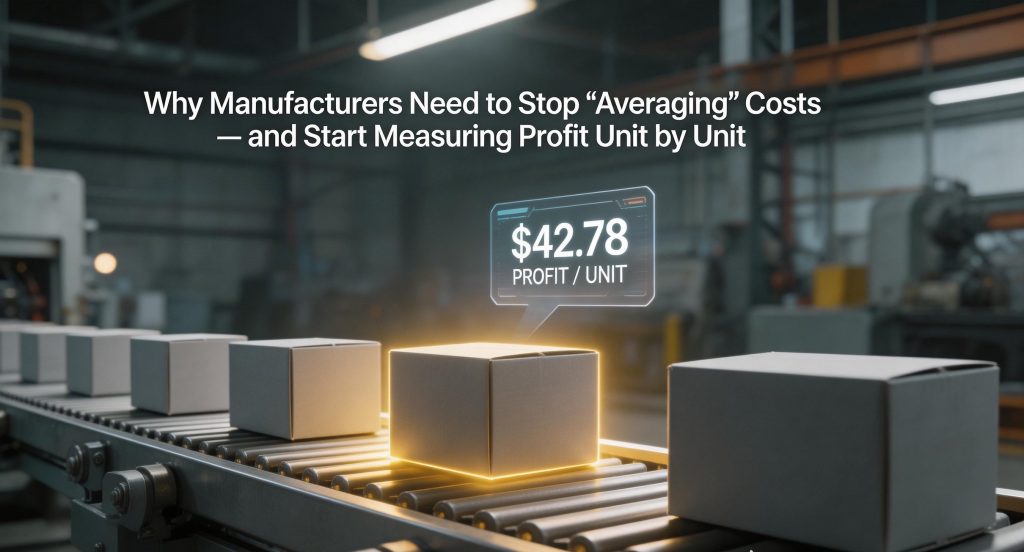
In many manufacturing companies, profitability is often reviewed too late.
By the time the monthly financial close is completed, the damage has already been done. Finance teams compare standard costs against actual costs, identify negative variances, and then begin the familiar exercise of tracing the root cause. They speak to operations, review maintenance logs, and investigate what happened weeks earlier.
That approach may have been acceptable in a slower business environment. Today, it is not.
When margins are tight, energy costs fluctuate, raw material prices move quickly, and customer expectations remain high, waiting until month-end to understand production inefficiency is simply too late. It does not prevent losses. It only explains them after they have already accumulated.
This is where Predictive Variance Analysis becomes strategically important.
By combining AI with live production, operational, and cost data, manufacturers can move from reactive reporting to real-time financial awareness. Instead of asking, “Why did we lose margin last month?” leadership teams can begin asking, “Where is margin slipping right now, and what should we do about it?”
Why traditional variance analysis is no longer enough
Traditional variance analysis plays an important role in management accounting, but it has a structural weakness: it is retrospective.
It tells management what happened after the period has ended. In practice, that means the business often discovers waste only after it has repeated itself for days or weeks.
This time lag creates what many manufacturers do not see clearly enough: a silent erosion of profitability.
A small increase in material usage may not trigger immediate alarm. A series of short machine interruptions may not register as major downtime. Slightly higher power consumption may not stand out in daily production reporting. Yet all of these issues compound into meaningful cost overruns over time.
By the time finance reports the variance, the company is no longer managing the issue. It is performing a post-mortem.
That is not good enough for organizations that want to be more agile, more efficient, and more competitive.
What a “cost leak” really looks like on the production line
Most cost leaks do not arrive as dramatic events. They emerge quietly through small, repeated inefficiencies.
A production line may experience frequent micro-stoppages that seem insignificant individually but reduce throughput, raise labor cost per unit, and increase wasted energy.
A dispensing or coating process may use slightly more material than required because a component has degraded or calibration has drifted. The excess may look trivial on a single batch, but across tens of thousands of units it can become a major margin issue.
A heating system may consume more energy to hold the same output because insulation or component performance has deteriorated. Output may still look normal, but the economics have changed.
These are the kinds of deviations that are easy for people to miss and difficult for traditional reporting to isolate quickly. AI, however, is particularly good at detecting these subtle patterns early.
How Predictive Variance Analysis works
At a high level, Predictive Variance Analysis relies on three capabilities working together.
1. A dynamic performance baseline
AI begins by learning what good performance looks like under different conditions. This is much more useful than relying only on a fixed standard cost.
Instead of assuming one static benchmark, the system can learn how a machine, line, or process should behave under a range of variables such as product mix, shift profile, humidity, operator experience, machine age, and raw material characteristics.
This creates a living baseline rather than a rigid assumption.
2. Real-time data from across the operation
The next requirement is continuous data flow from the production environment. This can include machine speeds, temperatures, pressures, downtime events, ERP work orders, raw material pricing, energy usage, vibration patterns, and sensor data from connected equipment.
The objective is not simply to collect more data. It is to combine operational and financial signals in a way that allows the business to detect economically meaningful changes as they develop.
3. AI-driven pattern recognition
The real value comes when AI identifies relationships that would be difficult for humans to detect consistently.
For example, a machine may still appear to be operating within acceptable limits, but subtle changes in vibration and energy consumption may indicate an early mechanical issue. AI can connect those signals, estimate the likely financial effect, and trigger an alert before the issue leads to scrap, unplanned downtime, or repair cost escalation.
In other words, the system does not just say that something is wrong. It helps estimate what that issue is likely to cost if nothing is done.
The shift from reporting to intervention
This is where the management value becomes very clear.
Predictive Variance Analysis changes finance from a department that explains the past into a function that helps shape immediate operational decisions.
Instead of waiting for a monthly report, leaders can receive timely, targeted alerts.
A floor supervisor may be notified that a specific line is consuming more raw material than expected and should be checked for calibration drift.
A procurement manager may be alerted that current material price movements are likely to compress margin on open work orders, allowing pricing or sourcing decisions to be reviewed before orders are completed.
An operations manager may see early warning signs that a production asset is entering a pre-failure state, enabling maintenance to intervene before the line suffers a major disruption.
This is a profound shift. The company is no longer just measuring performance. It is managing profitability while production is still in motion.
Why this matters to senior management
For management teams, Predictive Variance Analysis is not just an operational improvement initiative. It is a strategic capability.

Better margin protection
The most obvious benefit is stronger control over profitability. When cost leaks are detected earlier, the organization can reduce the gap between variance detection and corrective action.
That means less scrap, fewer hidden inefficiencies, lower rework, and less value lost to avoidable process drift.
Faster and better decision-making
When finance, operations, procurement, and maintenance are working from the same live view of cost performance, decision-making becomes faster and more aligned.
This reduces the friction caused by disconnected systems and delayed reporting. It also gives leadership better visibility into where margin risk is emerging across plants, lines, or product categories.
Greater agility in volatile markets
In a market where raw material prices, energy costs, and customer expectations can change quickly, businesses need more current visibility into their true operating cost.
If actual cost conditions are changing today, management should not have to wait until next month to see the impact. Predictive insight supports faster pricing adjustments, better production planning, and more disciplined commercial decisions.
Stronger working capital discipline
When cost behavior is more visible in real time, businesses can plan with greater confidence. They can reduce dependence on excessive safety buffers, contingency stock, and reactive spending driven by uncertainty.
That improves not only operations, but also cash discipline.
The organizational change required
Technology alone is not enough.
To make Predictive Variance Analysis work, the business must align around a new operating model.
Finance and operations must stop working from separate truths. The same underlying data should inform both financial management and production control.
Leadership must also be willing to trust forward-looking insight. That does not mean blindly following algorithms. It means treating AI as a practical decision-support capability that helps managers act earlier and with greater confidence.
Finally, data quality matters. Poor sensor health, inconsistent master data, weak process discipline, and fragmented systems will reduce the value of any AI initiative. Predictive performance requires reliable foundations.
The bigger message
The companies that perform best in the coming years will not be the ones that merely digitize reporting. They will be the ones that use data and AI to intervene earlier, decide faster, and protect margin more intelligently.
That is the real promise of Predictive Variance Analysis.
It allows manufacturers to move beyond the slow rhythm of the monthly close and toward a more responsive model of financial and operational control.
In that environment, finance becomes more than a reporting function. It becomes an active partner in daily performance improvement.
And that changes the conversation at the leadership level.
The question is no longer only, “How did we perform last month?”
The better question is:
“What is margin telling us right now, and what are we going to do about it before the day ends?”
Closing thought
For manufacturers, cost leaks are rarely caused by one dramatic failure. More often, they come from hundreds of small inefficiencies that go unnoticed until the financial results are already affected.
AI gives management the opportunity to see those signals earlier.
And in a business environment where every percentage point matters, earlier visibility is not just useful.
It is a competitive advantage.