COGS 2.0: Why Manufacturing Finance Must Stop Guessing Inventory Cost
Every month, many manufacturing companies go through the same painful ritual.
Finance closes the books.
Warehouse teams perform counts.
Production teams explain variances.
Management asks why margins are lower than expected.
Then everyone starts searching for the “missing money.”
In many factories, the biggest mystery is not revenue. It is not sales. It is not even production capacity.
It is Cost of Goods Sold, or COGS.
On paper, COGS looks simple:
COGS = Beginning Inventory + Purchases – Ending Inventory
But in the real world of manufacturing, this formula is much harder than it looks.
Because “ending inventory” is not static.
Raw materials are moving.
Work-in-progress is changing.
Finished goods are being packed and shipped.
Scrap is created.
Materials are transferred between warehouses, production lines, and staging areas.
And if these movements are not captured accurately, the company’s COGS becomes a guess.
That guess directly affects gross margin, profitability, tax calculation, audit confidence, and management decision-making.
This is where COGS 2.0 becomes important.
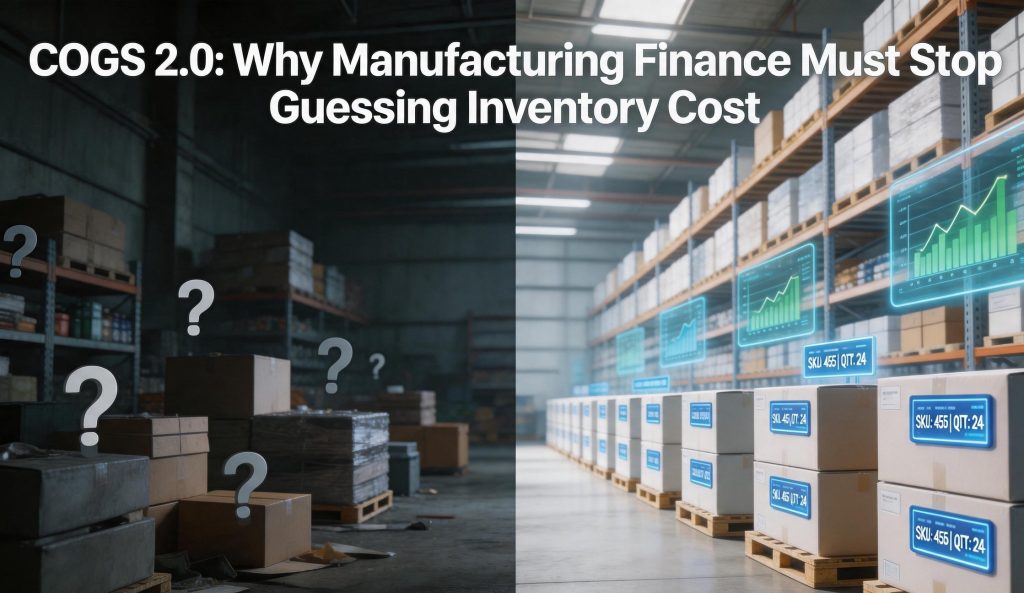
COGS 2.0 is the idea that manufacturers should no longer rely only on manual scanning, paper logs, delayed ERP updates, and month-end adjustments to know their true inventory cost.
Instead, they can use IoT data from the warehouse and production floor to automate inventory movement tracking and continuously reconcile COGS in near real time.
In simple terms:
The warehouse becomes a live financial ledger.
The Problem: Traditional COGS Reconciliation Is Too Slow
Many manufacturing companies still reconcile inventory and COGS using outdated processes.
A pallet is moved, but no one scans it.
A damaged component is thrown away, but no scrap record is created.
A worker miscounts physical stock during cycle counting.
A material issue happens on the production floor, but finance only sees the impact weeks later.
By the time the finance team discovers the variance, the root cause is already cold.
Was it scrap?
Was it theft?
Was it miscounting?
Was it wrong consumption?
Was it a production yield issue?
Was it a warehouse transfer error?
At month-end, the answer often becomes: “Let’s adjust it.”
This creates what I call the Reconciliation Gap.
It is the difference between what the ERP system thinks happened and what physically happened on the warehouse floor.
The bigger the gap, the more unreliable the company’s margin becomes.
And for high-volume manufacturers, even a small variance can represent a large financial impact.
A 1% COGS error may look small in a report.
But in a company with millions of dollars of monthly production, that 1% can destroy pricing accuracy, mislead management, and distort profitability.
—
The Three Biggest Reconciliation Killers
In many factories, COGS distortion usually comes from three operational issues.
### 1. The Scrap Leak
Scrap is one of the most dangerous sources of hidden cost.
When materials are damaged, rejected, expired, or wasted, they should be recorded properly.
But in reality, scrap is often handled informally.
A damaged part is thrown into a bin.
A rejected component is replaced quickly.
An operator continues production without logging the loss.
The ERP system still believes the material exists.
This creates a phantom asset.
The inventory is still visible in the system, but physically it is already gone.
Eventually, finance discovers the variance and writes it off.
But by then, the company may no longer know exactly when, where, or why the loss happened.
### 2. The Transfer Lag
Manufacturing inventory does not stay in one place.
Raw materials move from receiving to storage.
From storage to staging.
From staging to production.
From production to WIP.
From WIP to finished goods.
From finished goods to shipping.
Every movement matters financially.
If the ERP system is not updated at the same speed as physical movement, the books become disconnected from reality.
A pallet may already be consumed by production, but still appear as raw material inventory.
A batch may already become finished goods, but still appear as WIP.
This creates timing differences, wrong costing, and unreliable operational reporting.
### 3. Human Error in Cycle Counting
Manual counting is necessary in many environments, but it is not perfect.
People get tired.
Bins are mislabeled.
Items look similar.
Quantities are estimated.
Counting is rushed.
Data entry mistakes happen.
A worker may count 900 pieces when the actual quantity is 1,000.
Suddenly, finance sees a variance that does not actually exist.
The company then spends time investigating a problem caused not by theft, scrap, or production loss, but by simple human error.
This is expensive because people spend hours reconciling numbers instead of improving operations.
—
Why This Matters to the CFO
COGS is not just an accounting number.
COGS affects the entire financial truth of the business.
If COGS is wrong, gross margin is wrong.
If gross margin is wrong, product profitability is wrong.
If product profitability is wrong, pricing decisions are wrong.
If pricing decisions are wrong, strategy becomes dangerous.
Management may believe Product A is profitable when it is actually losing money.
They may discontinue Product B even though it is contributing healthy margin.
They may negotiate customer pricing using inaccurate cost assumptions.
They may reward the wrong production behavior.
This is why COGS accuracy is not only a finance issue.
It is a business survival issue.
—
The Shift: From Manual Reconciliation to Automated Verification
COGS 2.0 changes the model.
Instead of asking people to manually record every movement, the factory uses technology to verify what physically happened.
This does not mean replacing the ERP system.
The ERP remains the system of record.
But IoT becomes the system of physical truth.
The goal is to connect real warehouse activity with financial posting logic.
When inventory moves, the system knows.
When material is consumed, the system knows.
When scrap happens, the system knows.
When finished goods are produced, the system knows.
When shipment occurs, the system knows.
This allows finance to reconcile continuously, not only at month-end.
—
Technology Layer 1: RFID and BLE Tracking
The first layer is location and movement tracking.
Manufacturers can use RFID tags, BLE tags, smart gates, and readers to track pallets, bins, and high-value components.
For example, when a pallet moves from the raw material warehouse to the production area, the system automatically detects the movement.
This can trigger a transaction or recommendation in the ERP:
Raw Material → Work-in-Progress
The financial impact is not delayed until someone remembers to scan a barcode.
The movement is captured automatically.
This is especially useful for high-value materials, critical components, regulated goods, or fast-moving inventory.
The key principle is simple:
Do not track everything on day one.
Track the materials that matter most financially.
In many factories, 20% of inventory items may represent 80% of COGS value.
Start there.
—
Technology Layer 2: Smart Scales and Load Cells
Not all inventory can be counted by pieces.
Some materials are consumed by weight, volume, or flow.
Examples include:
Resin
Powder
Chemicals
Liquids
Grains
Metal parts
Fasteners
Packaging materials
For these items, smart scales and load cells can automatically detect quantity changes.
If a machine consumes 50kg of material, the system can record the reduction automatically.
This helps eliminate one of the biggest problems in manufacturing costing: theoretical consumption.
Many companies still calculate material usage based on standard formulas.
But actual usage may be different due to machine condition, operator behavior, humidity, temperature, rework, spillage, or process variation.
With IoT-based measurement, the company can compare:
Expected consumption vs. actual consumption
That comparison is extremely valuable.
It helps identify waste, leakage, abnormal usage, and hidden process inefficiency.
—
Technology Layer 3: Computer Vision for Scrap and Inventory Validation
Computer vision can add another layer of verification.
Cameras with AI models can monitor inventory areas, scrap bins, loading bays, and production points.
For example, if a defective component is thrown into a scrap bin, computer vision can help identify the item type and trigger a scrap event.
If a pallet is placed in the wrong area, the system can detect the mismatch.
If a staging area is supposed to contain 10 pallets but only 8 are visible, the system can flag the discrepancy.
Computer vision is powerful because it can capture events that people may forget to record.
It creates an additional audit trail between the physical world and the ERP system.
—
The Real Value: Autonomous Reconciliation
The true power of COGS 2.0 is not only collecting IoT data.
The real value comes when that data is used to automate reconciliation.
Imagine this workflow:
A pallet enters production.
The RFID gate detects it.
The ERP checks whether the transfer was recorded.
If not, the system flags a mismatch.
A supervisor receives an alert.
Finance sees the variance immediately.
The issue is corrected the same day.
This is very different from discovering the problem three weeks later during month-end close.
COGS 2.0 turns reconciliation from a monthly investigation into a continuous control process.
—
Continuous Cycle Counting
Traditional inventory counting is disruptive.
Some companies shut down operations for annual stocktake.
Others perform periodic cycle counts.
But these methods still depend heavily on manual effort.
With IoT, cycle counting becomes continuous.
Every movement becomes a validation point.
Every smart gate, sensor, scale, or camera becomes part of the audit process.
Instead of asking, “What is our inventory at the end of the month?”
The company can ask, “What is our inventory right now?”
That is a very different level of control.
—
Real-Time Scrap and Yield Analysis
One of the biggest advantages of COGS 2.0 is the ability to measure true yield.
Traditional method:
“We normally assume 3% waste.”
COGS 2.0 method:
“Batch #402 had 4.2% waste because Machine 3 had a temperature fluctuation.”
This is a major improvement.
It means the company can connect financial variance to operational root cause.
Finance no longer sees only the cost impact.
Operations can see what caused the cost impact.
This creates better collaboration between finance, production, warehouse, quality, and maintenance teams.
The conversation changes from:
“Why is COGS higher?”
To:
“Which machine, batch, material, supplier, or process caused the variance?”
That is where real improvement begins.
—
The CFO’s Dream: A Self-Closing Month
The ultimate goal of COGS 2.0 is the self-closing month.
This does not mean finance disappears.
It means finance spends less time chasing numbers and more time interpreting business performance.
If every major inventory movement is captured automatically, then ending inventory is always updated.
If ending inventory is always updated, COGS can be calculated much faster.
If COGS is accurate throughout the month, the month-end close becomes less painful.
The CFO can produce a more reliable profit and loss statement faster.
Management can see margin performance earlier.
Auditors can review stronger evidence.
Investors and lenders can have more confidence in inventory valuation.
This is not just an operational improvement.
It is a financial transformation.
—
Why Auditors Will Care
Inventory is often one of the most sensitive areas in audit.
Why?
Because inventory can be overstated.
Scrap can be hidden.
Shrinkage can be delayed.
Manual adjustments can be abused.
Cost assumptions can be inconsistent.
When a manufacturer has a strong IoT audit trail, it can provide better evidence.
The company can show when materials were received, moved, consumed, scrapped, converted, and shipped.
This improves traceability.
It reduces the dependency on manual explanations.
It also strengthens internal controls.
For companies seeking bank financing, investor confidence, or stronger governance, this can become a serious advantage.
—
How to Start: A Practical Roadmap
Manufacturers do not need to digitize everything at once.
A practical COGS 2.0 journey can begin in phases.
### Phase 1: Identify High-Value Inventory
Start with materials that have the highest impact on COGS.
These may include expensive raw materials, imported components, regulated materials, or items with frequent variance.
Do not start with low-value screws unless they create major operational issues.
Start where the financial impact is visible.
### Phase 2: Track Key Movement Points
Install RFID, BLE, barcode automation, weighing systems, or computer vision at critical transition points.
Examples:
Receiving
Warehouse storage
Production staging
Production consumption
Scrap area
Finished goods
Shipping
The objective is to capture inventory flow, not just inventory balance.
### Phase 3: Integrate IoT Data with ERP
IoT data must not live in isolation.
It should be integrated with ERP, inventory, production, and finance systems.
The system should be able to compare physical movement against ERP records.
When mismatch happens, it should trigger alerts, suggested adjustments, or approval workflows.
### Phase 4: Build the Reconciliation Layer
This is where AI and analytics become valuable.
The system can detect abnormal patterns such as:
Unexpected scrap increase
Unusual material consumption
Delayed transfer posting
Negative inventory risk
Wrong warehouse location
Batch yield deviation
Supplier quality issues
Machine-related waste
This layer turns raw IoT data into financial intelligence.
### Phase 5: Move Toward Predictive COGS
Once the system has enough data, manufacturers can start predicting cost issues before they become financial surprises.
For example:
“This batch is likely to exceed standard cost.”
“This machine is consuming more material than usual.”
“This supplier’s material has higher scrap risk.”
“This product line is showing margin erosion.”
That is when COGS becomes not just an accounting result, but an early warning system.
—
The Bigger Message: Finance Must Become Real-Time
Manufacturing has changed.
Production is faster.
Supply chains are more volatile.
Material prices change more frequently.
Customers demand better pricing.
Margins are under pressure.
Yet many finance processes still operate with delayed visibility.
That gap is dangerous.
A company cannot manage real-time operations with month-end financial truth.
COGS 2.0 closes that gap.
It connects the warehouse floor, production line, ERP system, and finance office into one continuous flow of information.
The result is better cost control, faster closing, stronger auditability, and more accurate profitability analysis.
—
Final Thought
For too long, manufacturers have accepted that inventory numbers will never perfectly match physical reality.
They accept adjustments.
They accept variance.
They accept guesswork.
They accept month-end firefighting.
But this is no longer necessary.
With IoT, smart sensors, RFID, computer vision, and AI-based reconciliation, manufacturers can move from inventory estimation to inventory truth.
COGS should not be a mystery discovered at month-end.
It should be a live signal flowing from the factory floor to the CFO’s dashboard.
The companies that achieve this will have a powerful advantage:
They will know their true cost.
They will know their true margin.
They will know their true profit.
In real time.
And in manufacturing, that may be the difference between competing on guesswork and competing with precision.
—